Canvas AI Agent
Overview
At the Skandalaris Hackathon 2025 (AI Track), my teammates DeYu Zhang, Mark Song, and I built Canvas AI Agent, an LLM-powered assistant that answers questions, summarizes materials, and surfaces deadlines from contextual Canvas course data. We earned a Runner-Up Award (Top 5 overall) and $500 in prizes.
Since then I have kept working on my own fork, turning a demo that worked into a system I can prove works.
The hackathon build
React + TypeScript chat frontend over WebSocket streaming; FastAPI
backend with async handling, Azure OpenAI (gpt-4.1-mini)
for query understanding and tool invocation, OpenAI Vector Stores for
semantic search over course materials, and the Canvas LMS API for
student-accessible resources.
Making it measurable
The demo worked, but nothing about it was measured. I built the evaluation first and let it tell me what to fix: a factorial experiment over knowledge-base access and question wording, graded by a different model family (Claude judging GPT output) using a rubric that separates fabrication from false refusal.
| Without KB | With KB | |
|---|---|---|
| Fully correct | 0 / 18 | 17 / 35 |
| Grounded in course material | 0 | 25 / 35 |
| Refusals | 17 | 3 |
| Fabricated content | 0 | 3 |
That asymmetry is the point. Without retrieval the agent politely refuses — harmless-looking in a single metric; with retrieval it answers correctly far more often but occasionally invents a source. One number would have hidden both failure modes.
Real bugs fell out once the harness existed. Asking "who teaches this
course?" burned fifteen identical API calls and 460K input tokens before
giving up: the tool advertised include=teachers, requested
it, then dropped the field while formatting. A model that asks for
teachers and receives none concludes it passed the argument wrong — and
retries forever. Separately, Canvas's announcements endpoint silently
defaults to a 14-day window: 0 announcements for a concluded course, 18
with an explicit semester range.
Both share one root cause: the model cannot question what it
cannot see. API contracts now live in tool descriptions, errors
surface verbatim (HTTP 404 ... /quizzes, not
Resource not found), list rendering always reports counts
including zero, and identical repeated calls are short-circuited. The
agent now reads the raw 404 and pivots on its own — no prompt rule
needed.
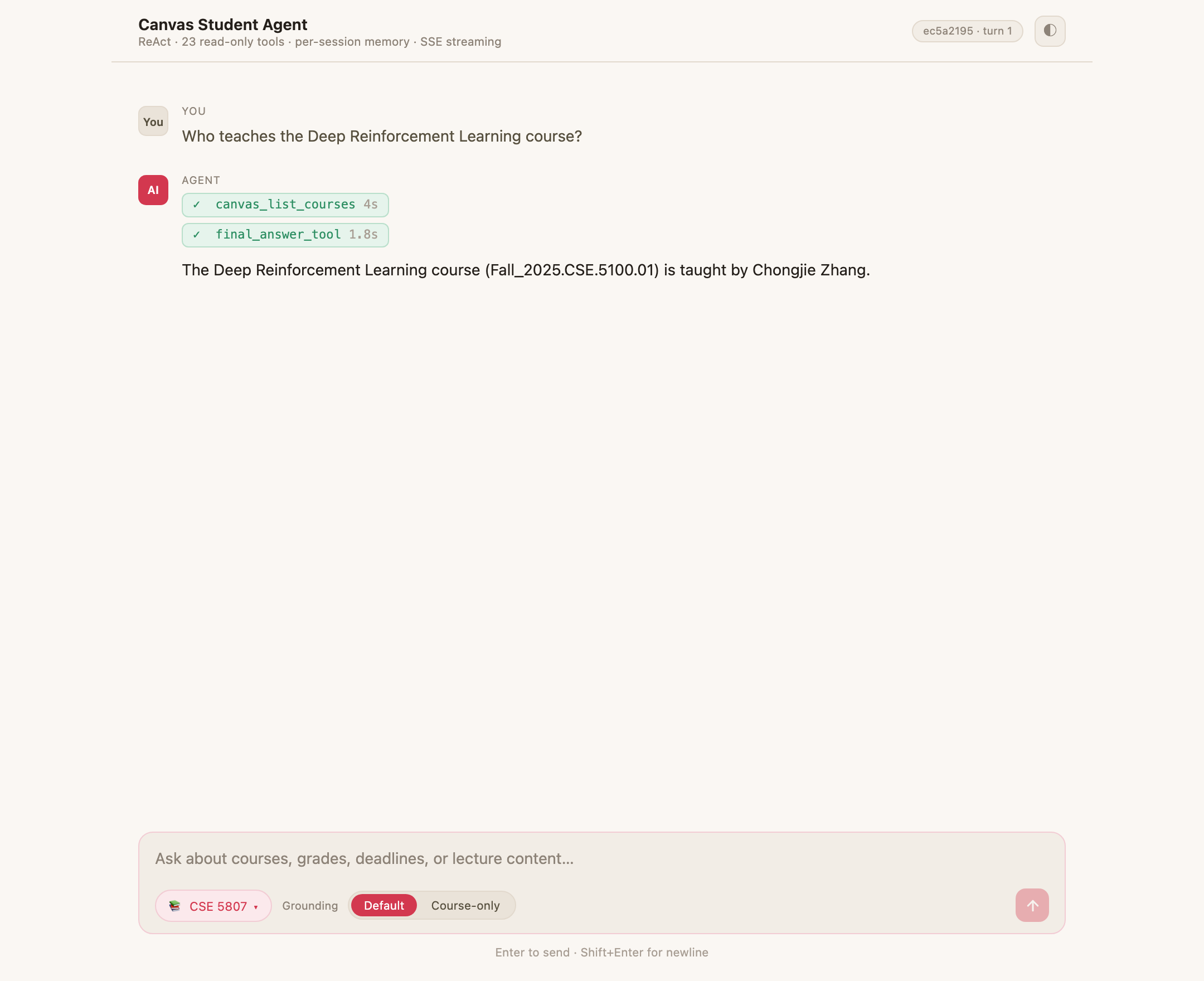
The same question that once looped fifteen times now resolves in two calls, with each step and its latency visible as it streams.
The interface
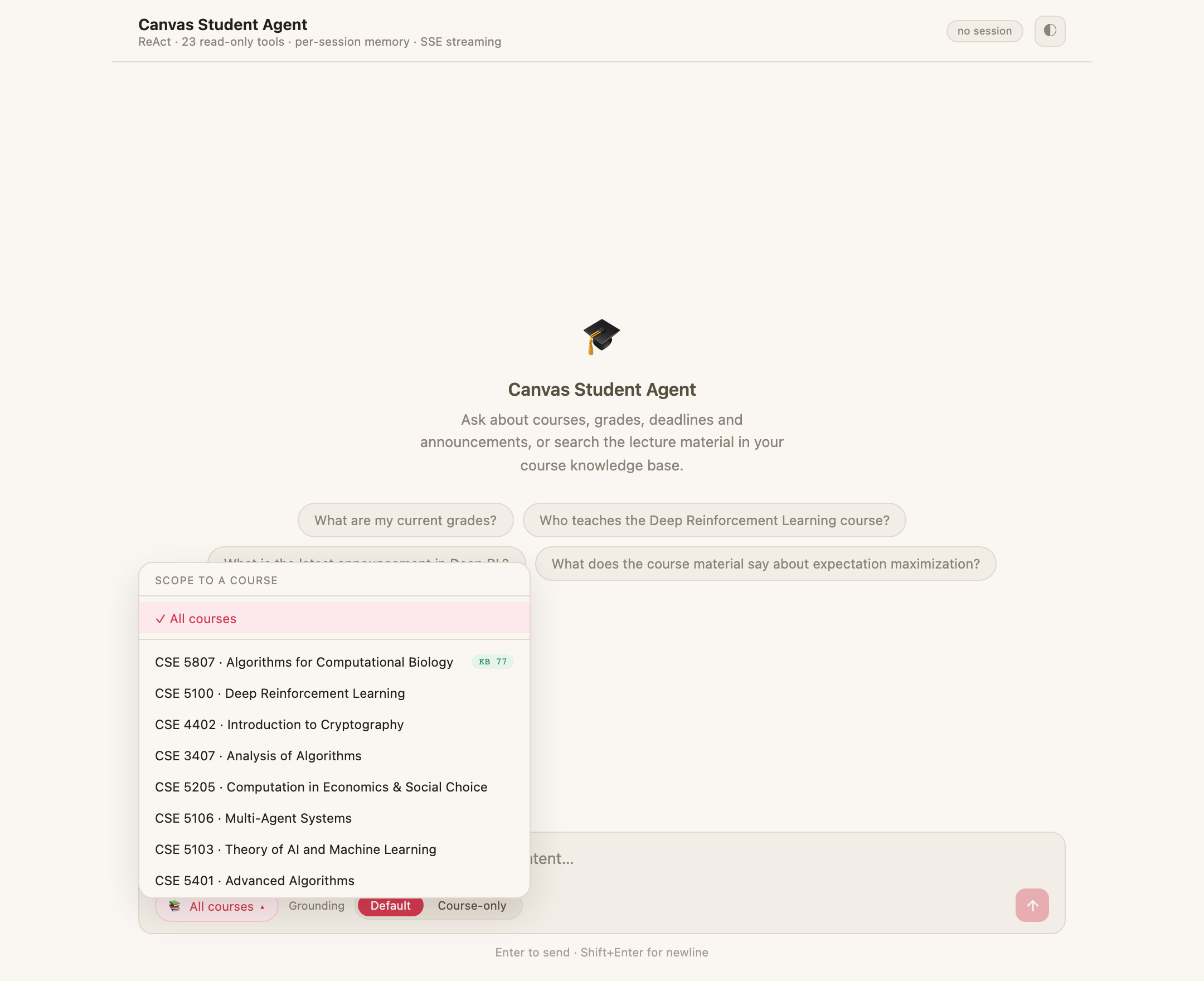
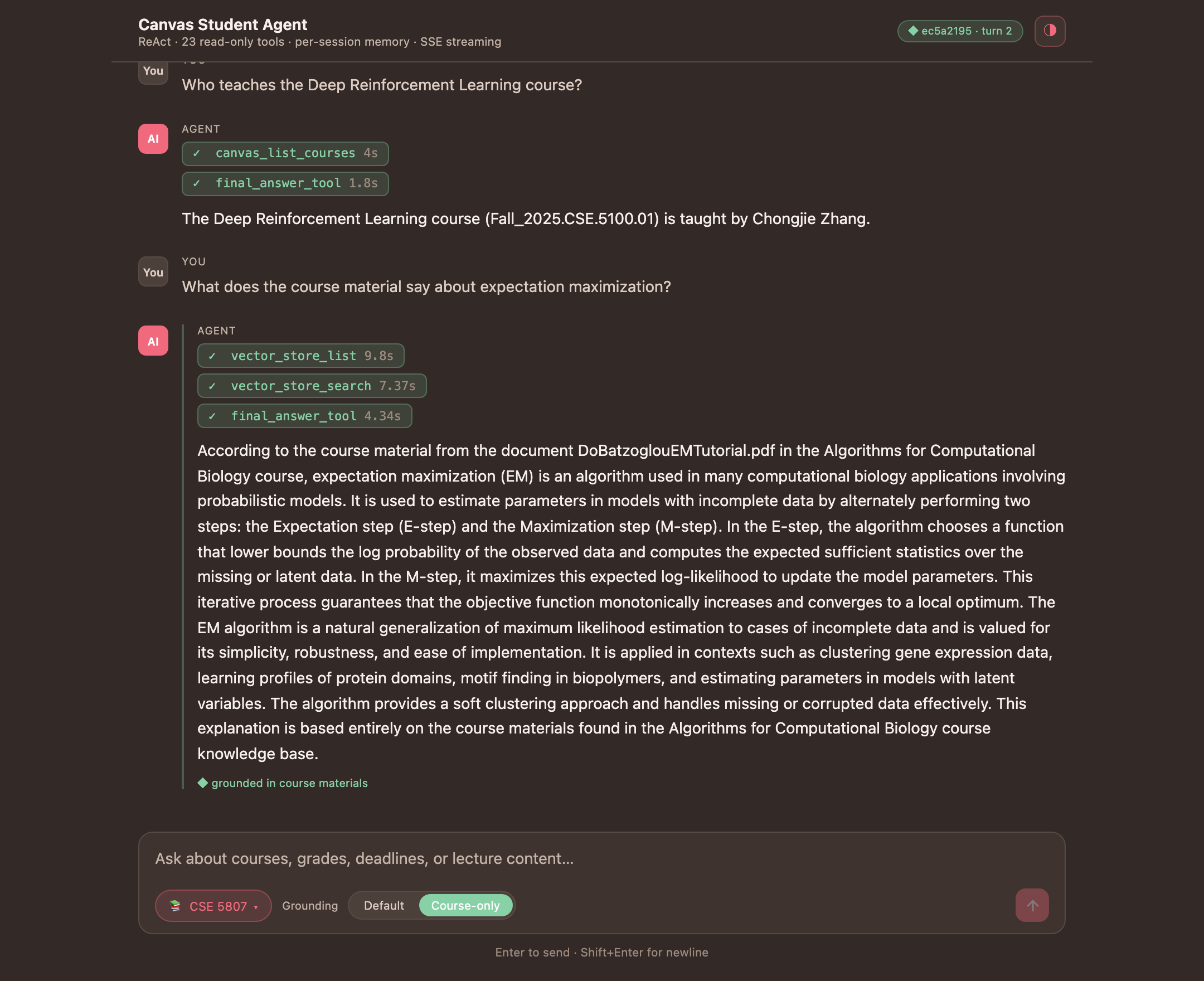
Course scope narrows the agent to one class; a KB badge marks which courses have a knowledge base built from their materials.
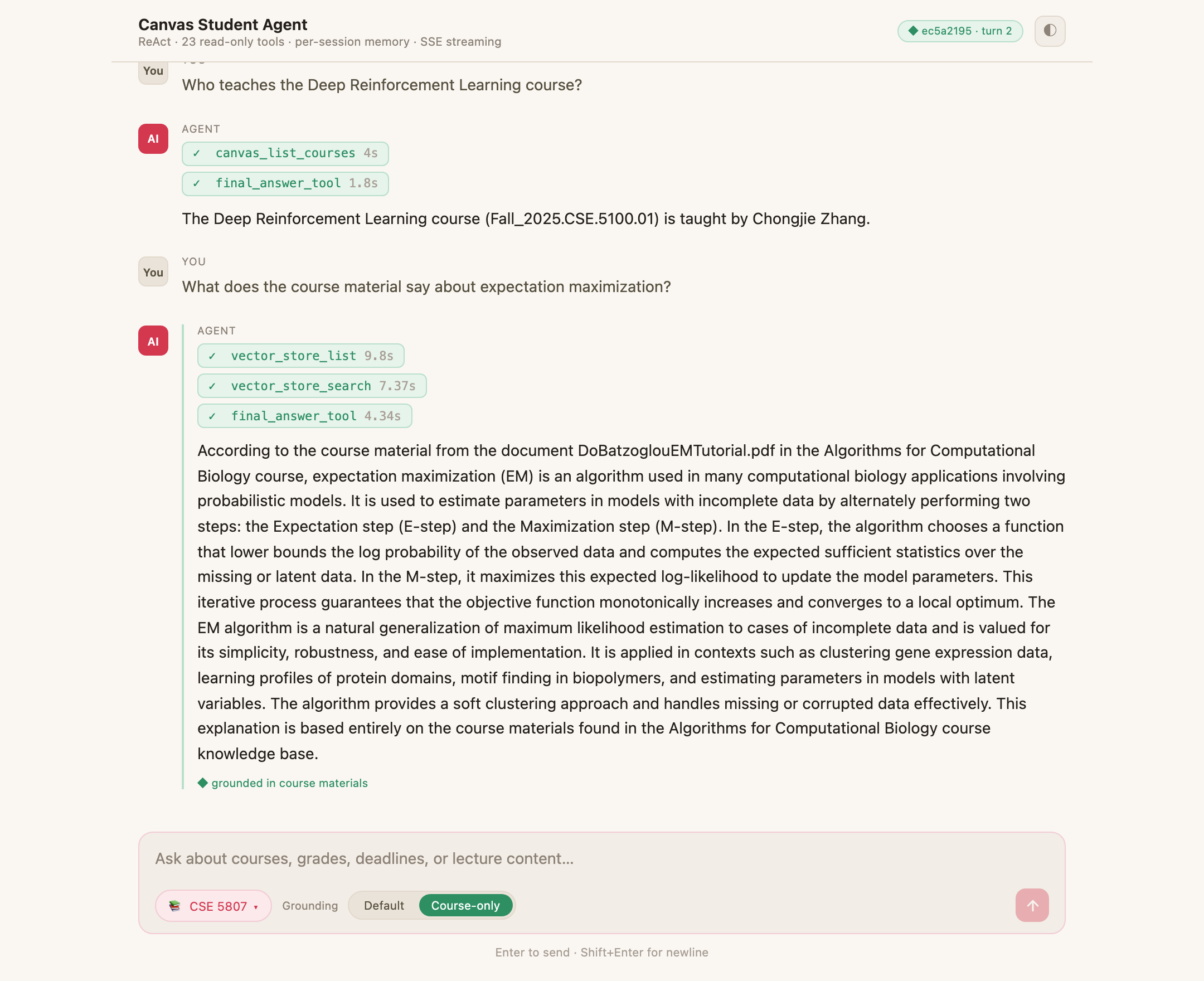
A grounding toggle switches to course-only mode, and answers are then labeled by provenance — grounded in course materials, or explicitly not found in them. That label is the interface counterpart of the attribution classes the RAG evaluation measures.
Other engineering
- Bounded multi-turn memory — compaction cut an eight-turn session from 438K to 166K input tokens (62%), recall verified intact.
- Per-session agents — concurrent users run in parallel with isolated context, over SSE and WebSocket sharing one event model. Worth measuring first: under ReAct with forced tool calling the model emits zero free-text deltas, so there is nothing token-level to stream.
- Read-only as a mechanism, not a convention — every
tool carries a
side_effectattribute filtered at build time, guarded by a CI assertion. Verified by re-enabling a write tool: it still cannot get in. - 76 deterministic cases across seven suites on every pull request, Python 3.11 and 3.13, no API keys and no network. Proven by planting a phantom tool name and watching CI go red. The expensive LLM evals stay manual: a low-change repo produces identical scheduled runs at real cost for no new signal.
Links
- My fork — eval harness, RAG ablation, CI, streaming, MCP server
- Team repository — hackathon build
- Cloudflare Workers version — Workers AI + SQLite Durable Objects
- Demo slides
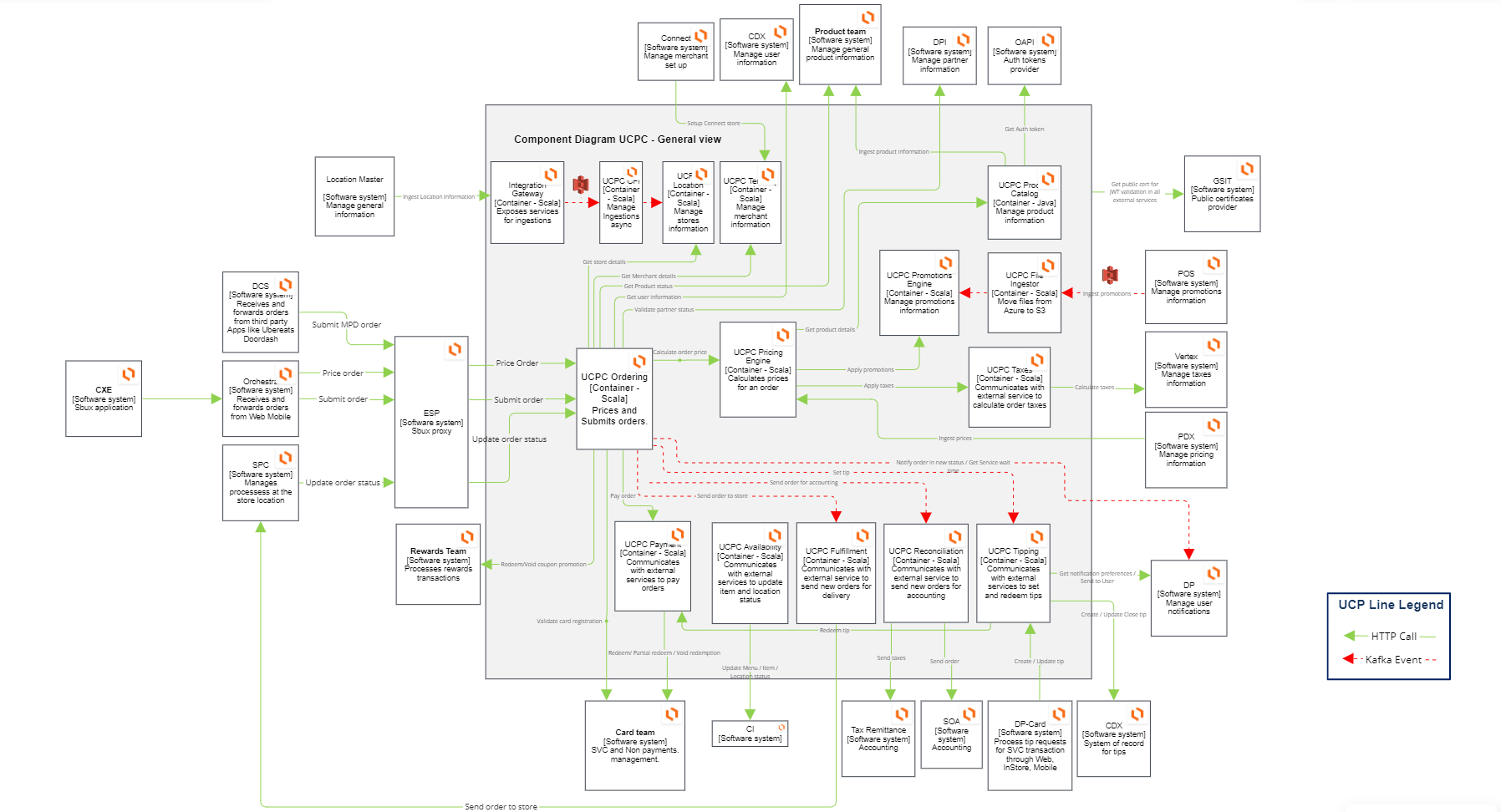 Teams and service
ownership
Teams and service
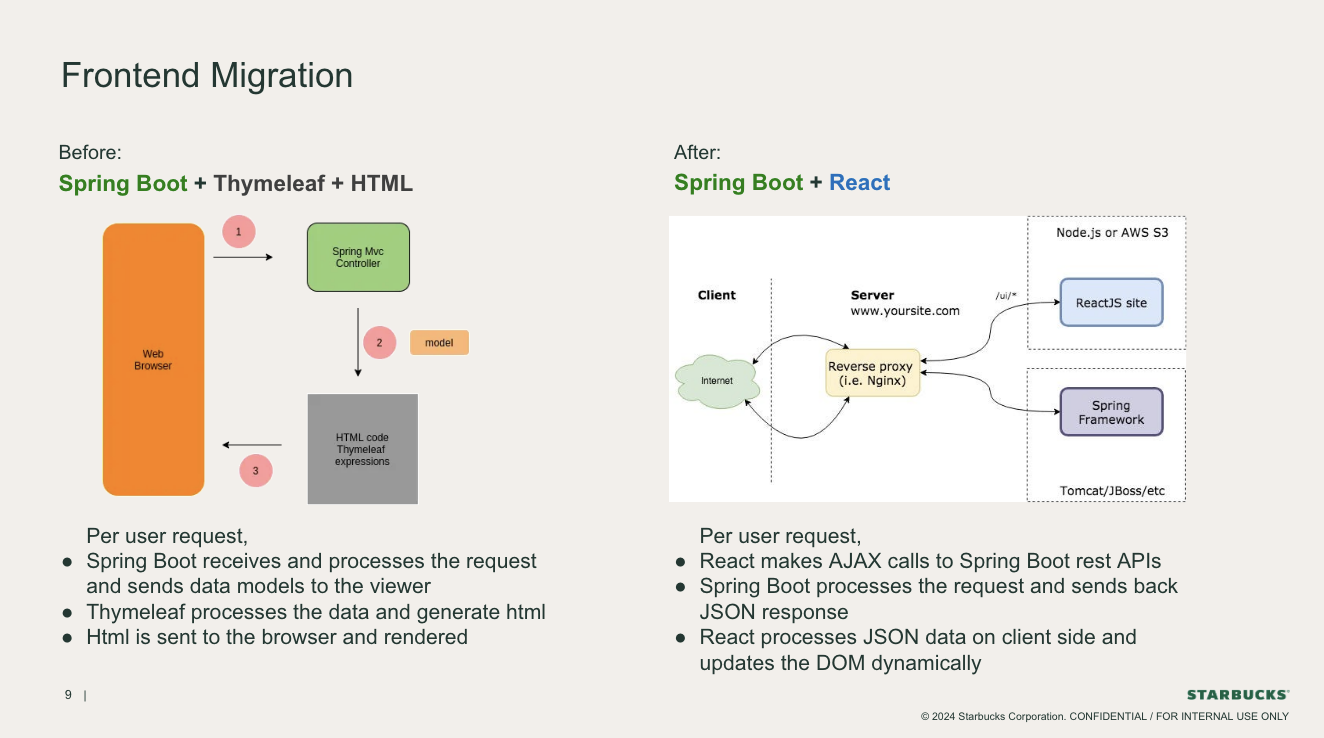
ownership 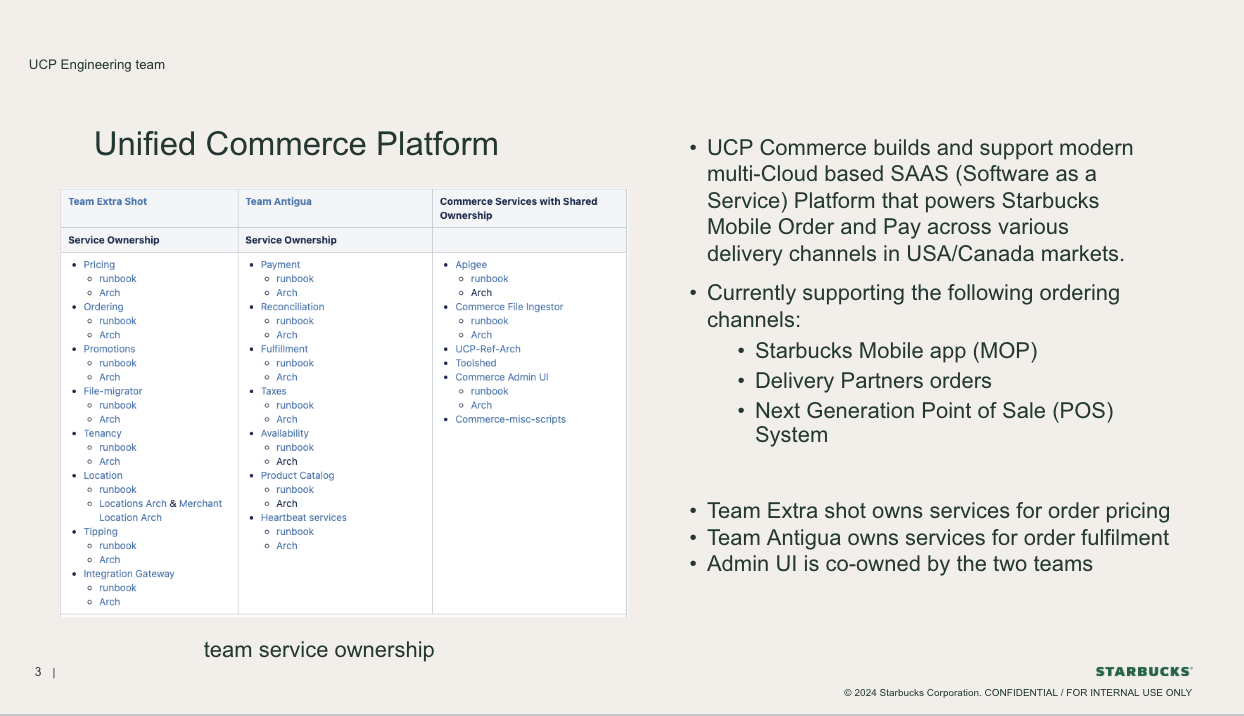 Frontend migration plan
  Home page
and navigation
Home page
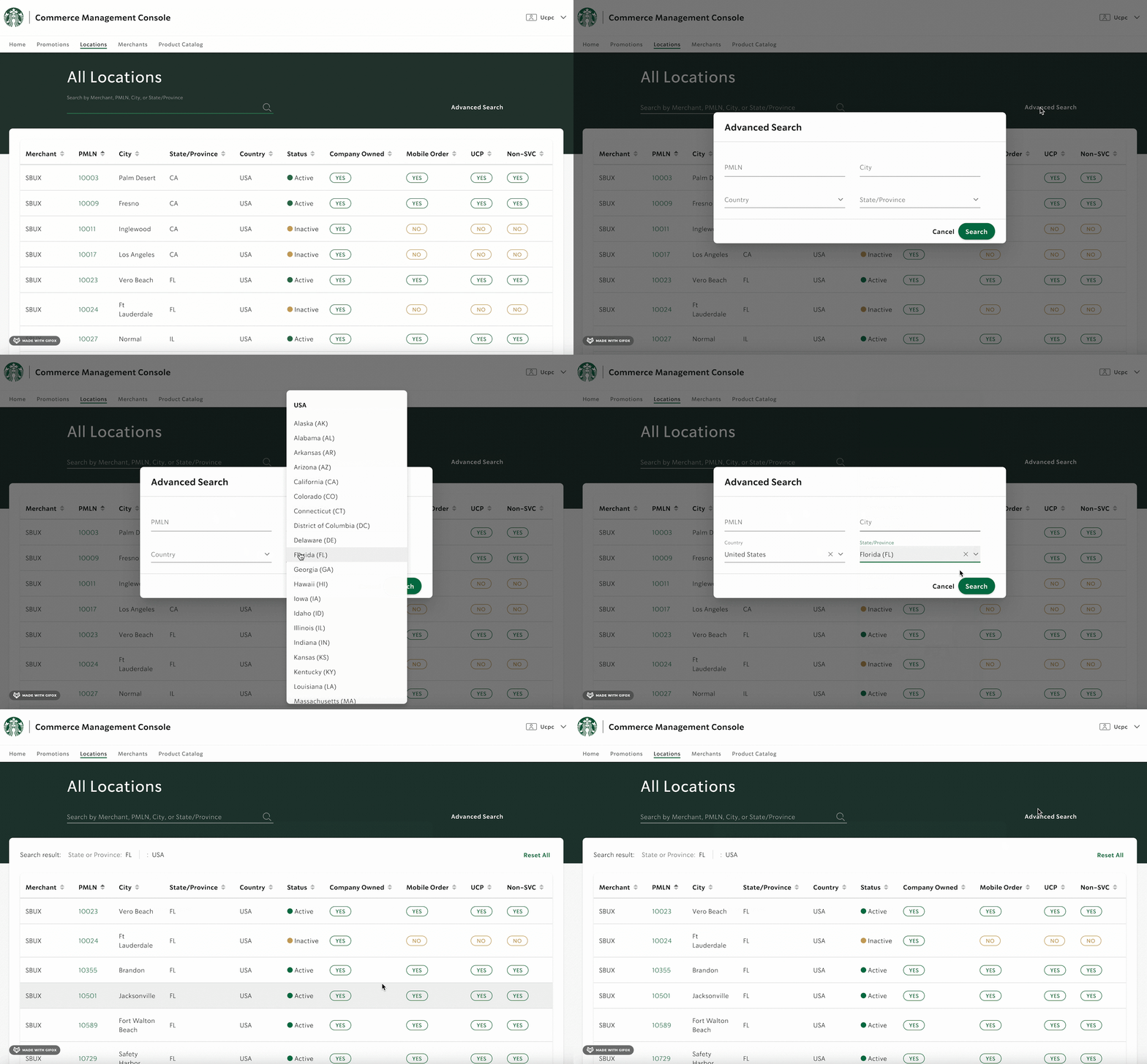
and navigation 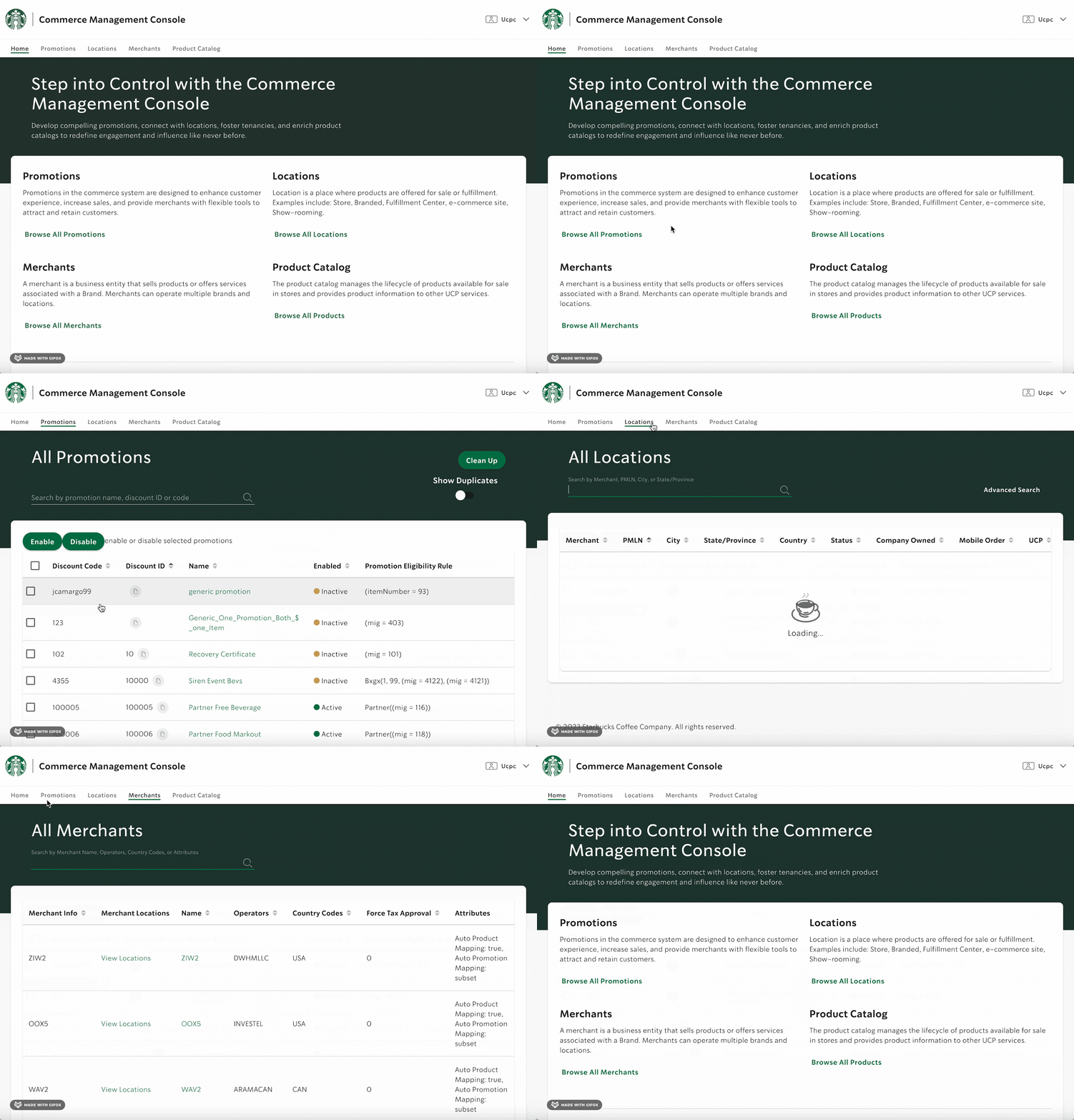 advanced search
  Filter and
page linking
Filter and
page linking 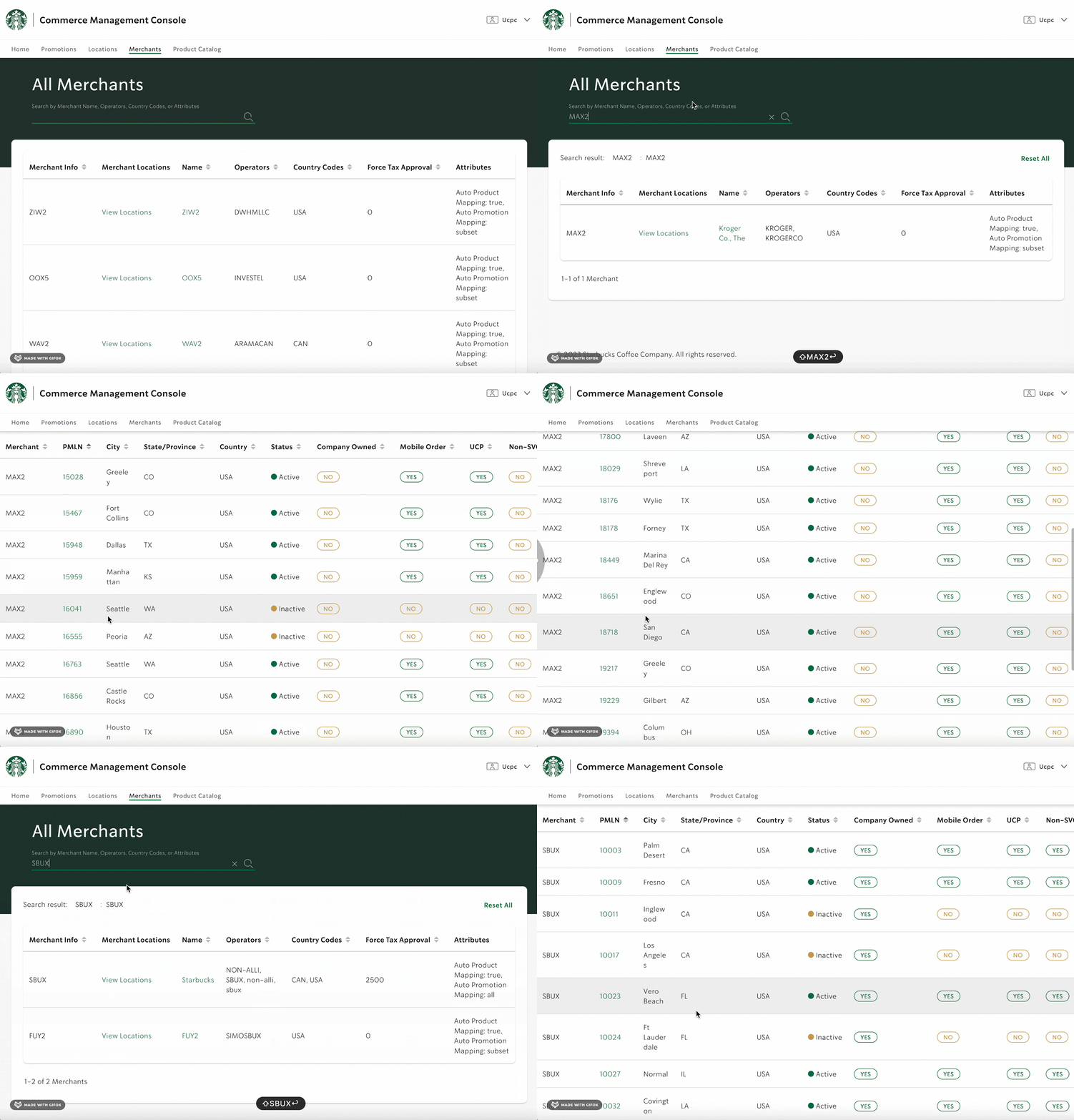 Detail page
  Full presentation